Description of the cathedral
Let’s begin our description of Beauvais’ Saint-Pierre Cathedral with its choir, before discovering its historiated capitals and its two great 16th-century portals.
The choir
The choir has the tallest vault of any Gothic choir: 46.7 m. Only the apse’s vault retains its original shape. After the partial collapse of 1284, the choir was rebuilt in the 14th century with additional piers, and the vaults became six-part, as they remain today.
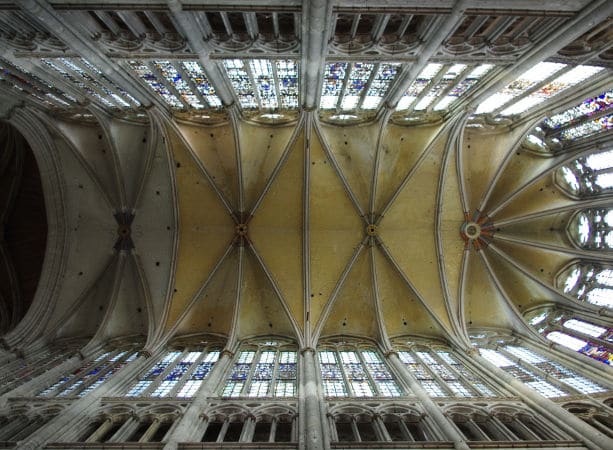
The westernmost part, bordering the transept, is a 16th-century reconstruction following the collapse of the lantern tower in 1573.
Slide the cursor over the photo below to make the additional piers — added after the choir’s 1284 collapse — disappear, and discover what the choir must have looked like before.
The choir before the collapse
The choir after the piers were added
Details of the choir’s capitals
13th-century capitals
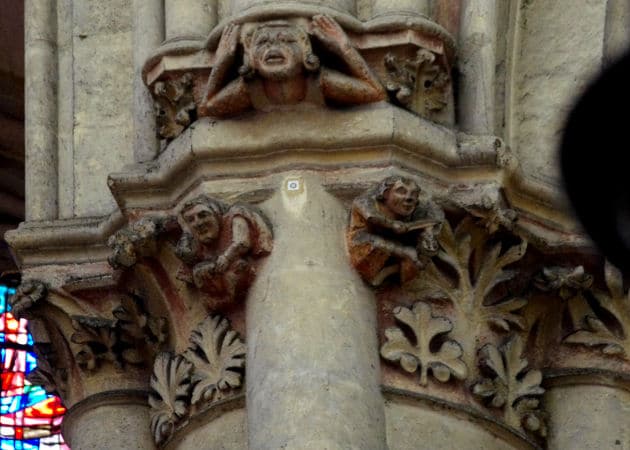
The musicians
On the left is likely a drummer with his right hand raised. On the right, a player of the vielle or rebec.
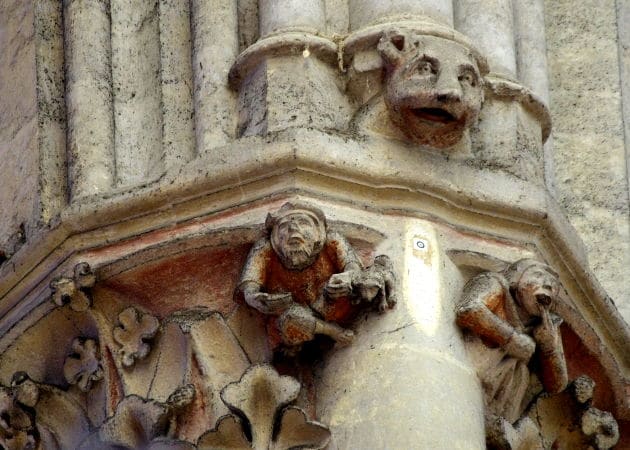
The beggar and the rich man
On the left is likely a seated beggar with his dog, a bowl resting on his knee. The second, chubby-cheeked figure lifts the hem of his coat before easing his stomach.
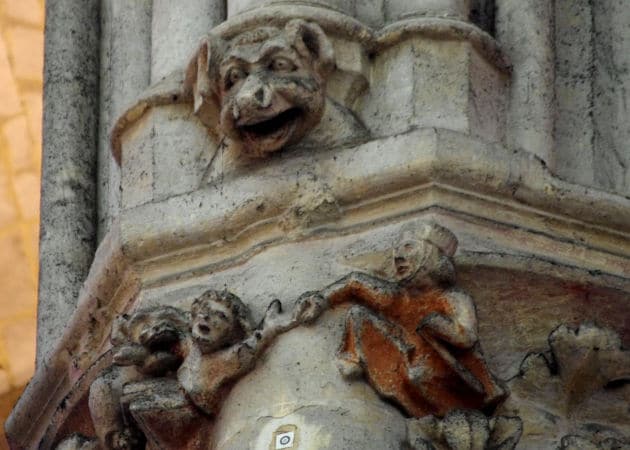
The mother and son
This depicts a dramatic scene. The mother, on the right, braces her foot against the column to pull her son (also on the right), whose arm is caught in the jaws of a monster whose body ends like a serpent’s.
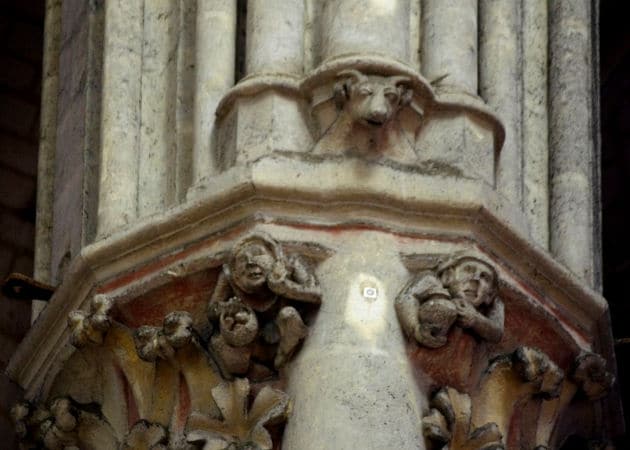
The basket and the jug
On the left, the figure carries a basket holding three small loaves of bread. The figure on the right carries a jug. What does it contain?
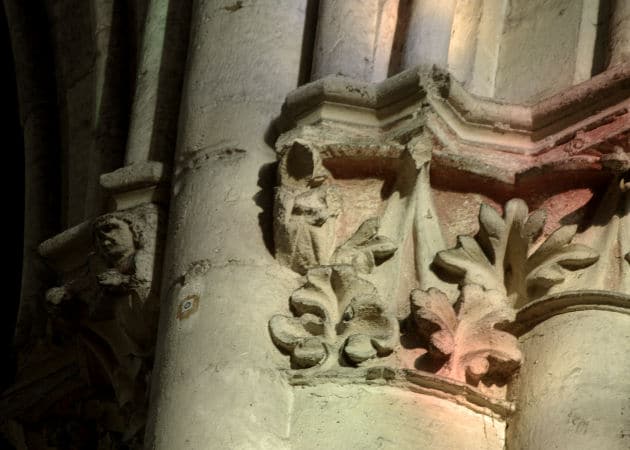
The angel and the ghost
The figure on the left is an angel (one of its wings is visible from another angle), hands joined together. The figure on the right has no face, which, in certain lighting, makes it look like a ghost. Did it ever have a face?
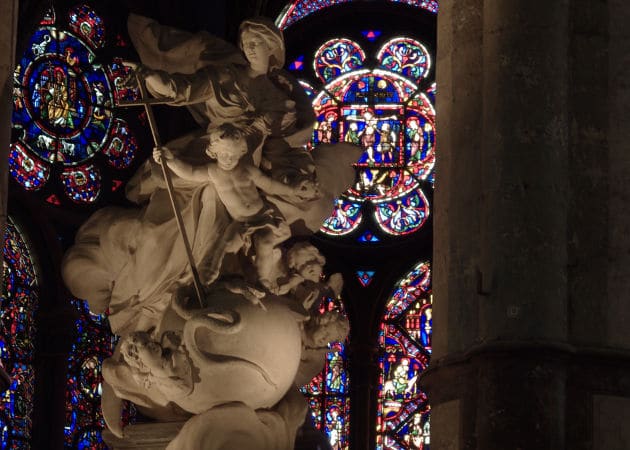
Statue of the Virgin and Child crushing the serpent
In the choir stands a plaster sculpture by Nicolas-Sébastien Adam, commissioned in 1755 by the cathedral chapter. It depicts the Virgin upon the clouds. Below, the Christ Child, standing on a globe, crushes the serpent with his cross. A depiction of the same scene, dating from the mid-19th century, can be found on the back of the astronomical clock.
The south portal
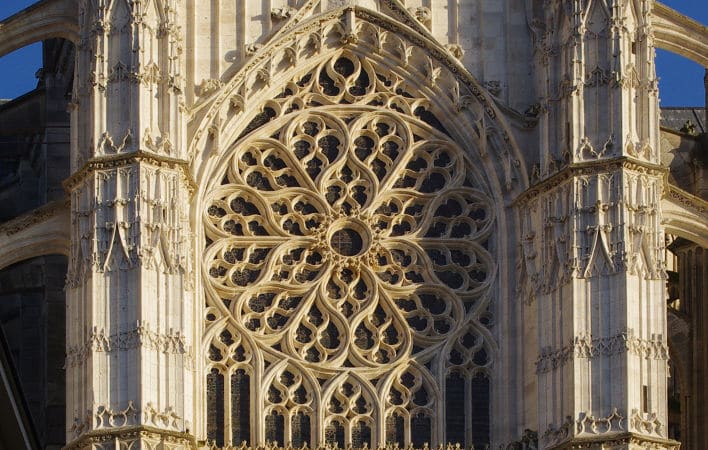
The south portal of Beauvais’ Saint-Pierre Cathedral is a 16th-century masterpiece by the architect Martin Chambiges.
The rose window of the south façade
The doors
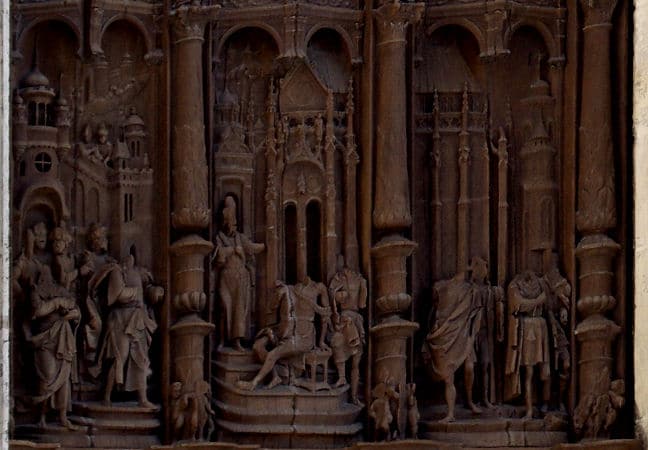
The door of Saint Peter
The door of Saint Peter, a work attributed to Jean Le Pot, dates from around 1540 in the 16th century. During the Revolution, several heads were cut off. This left-hand door depicts an episode from the life of Saint Peter: the healing of a paralytic.
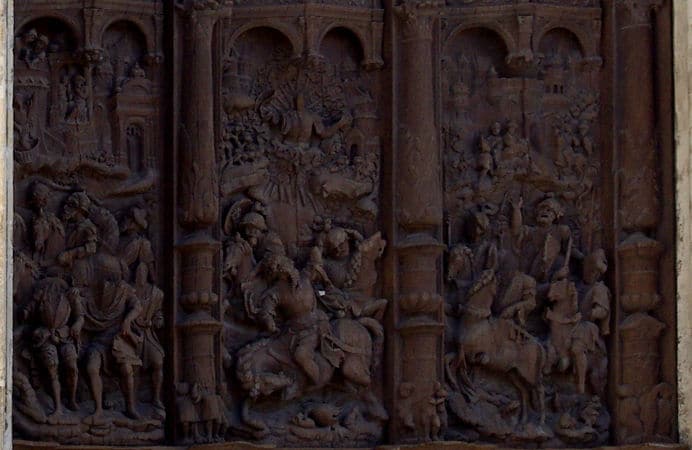
The door of Saint Paul
Also from the 16th century, around 1540, the right-hand door, called the Door of Saint Paul, is likewise attributed to Jean Le Pot. It depicts an episode from the life of Saint Paul: his conversion on the road to Damascus.
The carved decoration
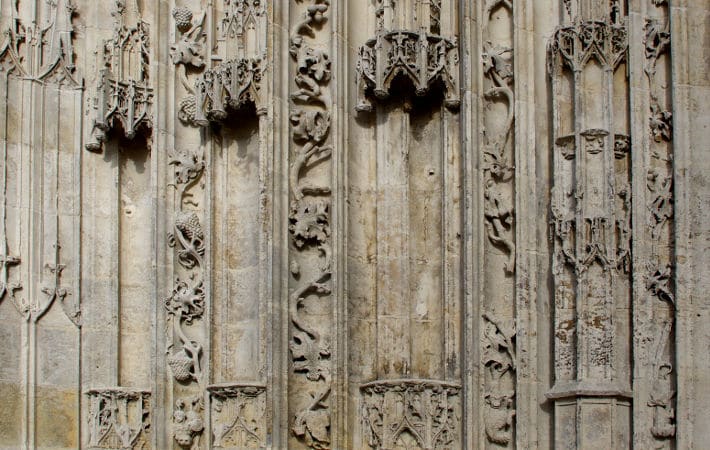
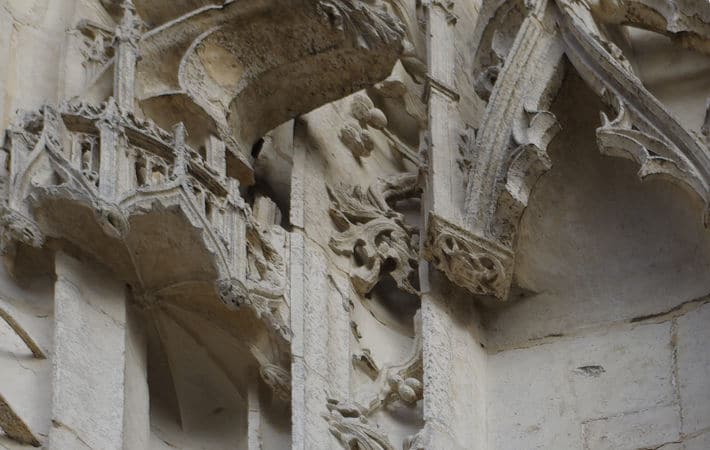
The bryony
Bryony is a climbing plant whose fruits are often grouped in threes, in a trilobed shape. This feature, evoking the Trinity, is why it is depicted on cathedral portals such as those of Lyon and Sens, and here at Beauvais.
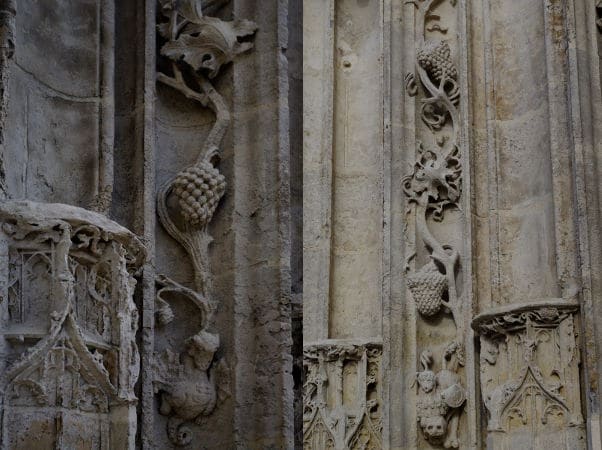
The grapevine
The grapevine is a biblical symbol of abundance found repeatedly in both the Old and New Testaments. When it is abundant and bears fruit, it expresses blessing. That blessing must extend to all: the vineyard owner must not go back through the vineyard to gather forgotten clusters, but must leave them for the poor and the stranger.
In the New Testament, the vineyard symbolizes the Kingdom of God, which one must labor for during earthly life. “You also go into my vineyard” (Matthew 20:4).
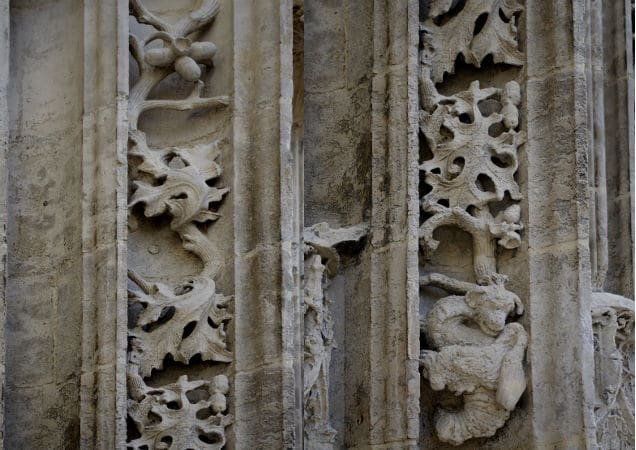
The oak
In the Bible, the oak is a symbol of strength and solidity. It is also beneath the oaks of Mamre that Abraham receives the visit of the Lord. “The Lord appeared to him by the oaks of Mamre, as he sat at the entrance of his tent in the heat of the day. He lifted up his eyes and looked, and behold, three men were standing near him.” (Genesis 18:1–2)
The north portal
The north portal of Beauvais’ Saint-Pierre Cathedral is somewhat less ornate than the south portal, which serves as the main entrance. It dates from the early 16th century.
The Tree of Jesse
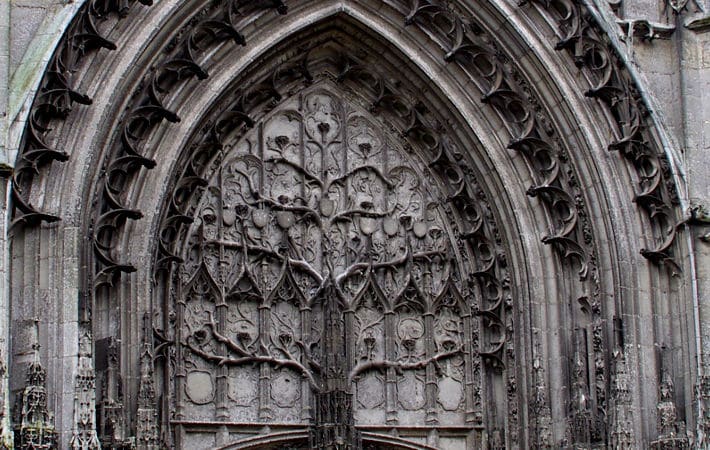
The doors
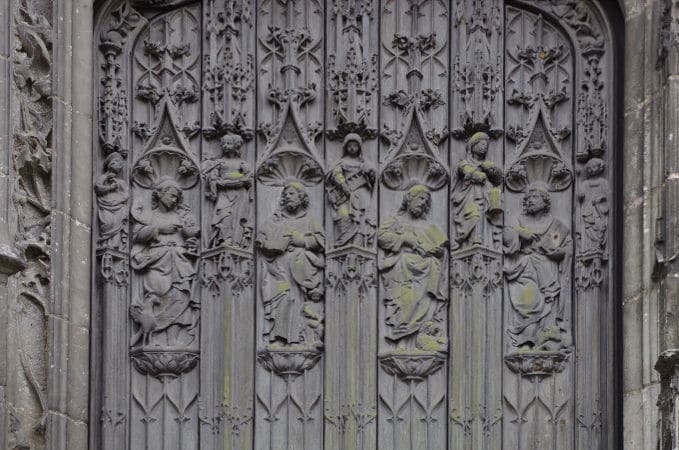
The door of the Evangelists
The door of the Evangelists depicts the four evangelists with their symbols: the eagle for Saint John, the man for Saint Matthew, the lion for Saint Mark, and the ox for Saint Luke.
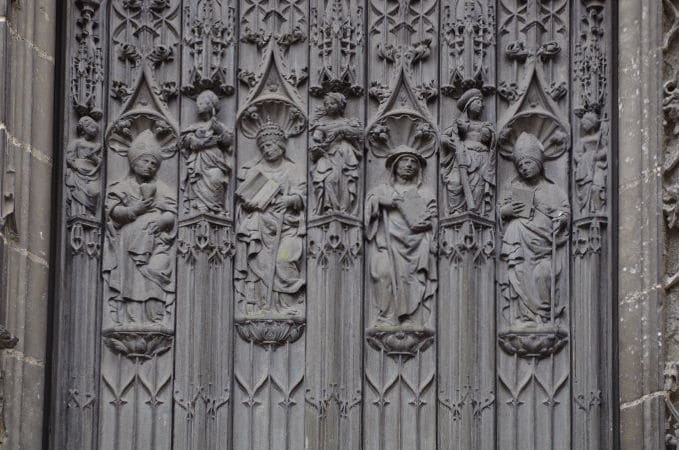
The door of the Doctors of the Church
The door of the Doctors of the Church depicts the four doctors of the Latin Church (as also seen on the south transept’s stained-glass window). From left to right:
Saint Augustine, bishop of Hippo in North Africa; Saint Gregory the Great, pope; Saint Jerome (347–420), who translated the Bible into Latin; and Saint Ambrose (340–397), bishop of Milan, who converted Saint Augustine when he had come to study in Milan.
The stained-glass windows and the cloister
After the architecture and sculptures, continue your visit with the cathedral’s stained-glass windows and the cloister buildings.