
Astronomical Clocks Around the World: Beauvais Among the Great Masterpieces of Time
From Prague to Strasbourg, from Gdańsk to Venice, astronomical clocks have combined mechanics, astronomy, art and the measurement of time for centuries. Explore their geographical distribution and discover the remarkable place occupied by the two astronomical clocks of Beauvais Cathedral.
Much more than clocks
An astronomical clock combines the indication of time with one or more astronomical displays: the apparent movement of the Sun and Moon, lunar phases, calendars, signs of the zodiac, positions of celestial bodies or other recurring astronomical phenomena.
Some consist of little more than a lunar dial. Others are monumental mechanical masterpieces, incorporating thousands of components together with calendars, automata and representations of the solar system.
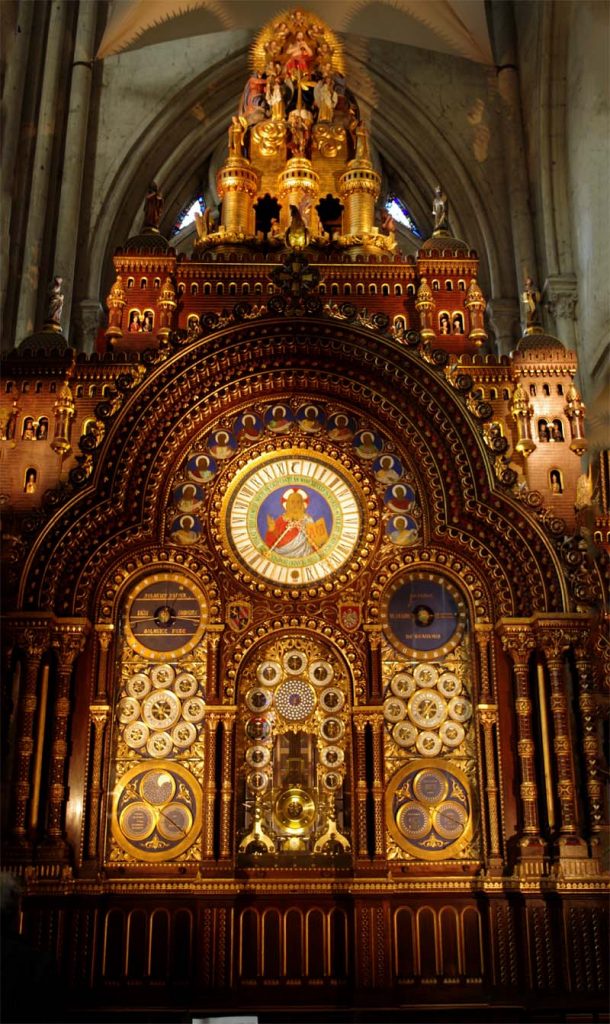
Beauvais Cathedral houses two astronomical clocks
Saint Peter’s Cathedral in Beauvais has a remarkable feature: it houses two astronomical clocks representing two very different periods in the history of clockmaking.
The medieval clock traditionally associated with Canon Musique preserves elements dating from the early 14th century. It is regarded as the oldest chiming clock still in operation.
Only a few metres away stands the monumental astronomical clock built between 1865 and 1868 by Auguste-Lucien Vérité. Approximately twelve metres high, it is one of the most spectacular achievements of 19th-century monumental clockmaking.
Map of astronomical clocks
Each marker represents an astronomical clock included in this inventory. Click a marker, then select “View entry” to jump directly to its dedicated section below.
Astronomical clocks listed
Search by city, monument or country, or display only clocks whose current operating status has been documented.
An evolving documentary inventory
This inventory is based primarily on Wikipedia lists and articles devoted to astronomical clocks, supplemented whenever possible by information published by the monuments, museums and tourism organisations responsible for their preservation.
As Wikipedia does not currently provide a completely exhaustive worldwide inventory, this page should not be regarded as a definitive list. It is intended to be expanded as additional documented information becomes available.
What does “documented as operating” mean?
This status is used when a recent source confirms that the clock, its mechanism or its automata remain in operation. Where only the existence and preservation of a clock are documented, its status is marked “to be confirmed” rather than assuming that the mechanism is still operational.
Discover the astronomical clocks of Beauvais
In Beauvais, several centuries of clockmaking history can be discovered within the same monument: from the medieval clock associated with Canon Musique to the monumental masterpiece created by Auguste-Lucien Vérité.