The choir capitals,
a sculpted world to discover
Expressive faces, musicians, animals and fantastic creatures hide among stone foliage. At the tops of the piers, the capitals invite you to see the cathedral in a new light.
Between the piers and the vaults, stone comes to life
As you enter Beauvais Cathedral, your gaze is naturally drawn to the height of the vaults. Yet a little lower down, where the choir’s great arches spring from the piers, a wealth of decoration unfolds that could easily go unnoticed.
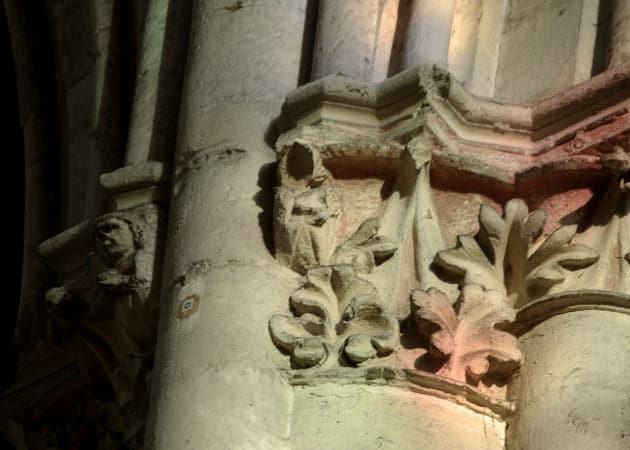
A capital is the widened upper part of a pier or column, forming the transition to the arch it supports. In Beauvais, these architectural elements feature foliage alongside human and animal figures, some of them quite surprising.
Their silhouettes, gestures and expressions reward close observation. Some details are instantly recognisable; others retain an air of mystery.
Sculptures that bear witness to the building’s history
The capitals vary in both shape and decoration. These differences reflect the stages of the cathedral’s construction and its later alterations.
Most of the piers supporting the choir’s great arcades date from the 13th century. After the partial collapse of the vaults in 1284, three additional piers were inserted on each side of the straight section of the choir to strengthen the building.
In the 16th century, the collapse of the lantern tower in 1573 brought down the first two piers on the north side of the choir. Their reconstruction introduced a different style.
From one pier to the next, observing the shapes and sculptures offers another way to read the cathedral’s eventful history.
Heads that intrigue and raise questions
Several 13th-century capitals are topped by carved heads forming corbels at the springing of the arches. In the straight section of the choir, the human figures have pronounced, sometimes caricature-like expressions.
Could they evoke gluttony, sloth or anger? These readings remain hypotheses: the precise meaning of the figures is not always known.
In the rounded section of the choir, the heads take animal forms. One recalls a smiling bear, another a pig with a flat snout; elsewhere, horns, large ears or teeth in a half-open mouth appear.
Even when the animal is difficult to identify, the sculpture’s expression catches the eye. These figures lend a distinctive presence to the architecture.
Figures and stories to decipher
So-called “historiated” capitals depict figures or scenes. On those dating from the 13th century, the figures occupy the side facing the sanctuary. Musicians, enigmatic scenes and fantastic figures invite a closer look.
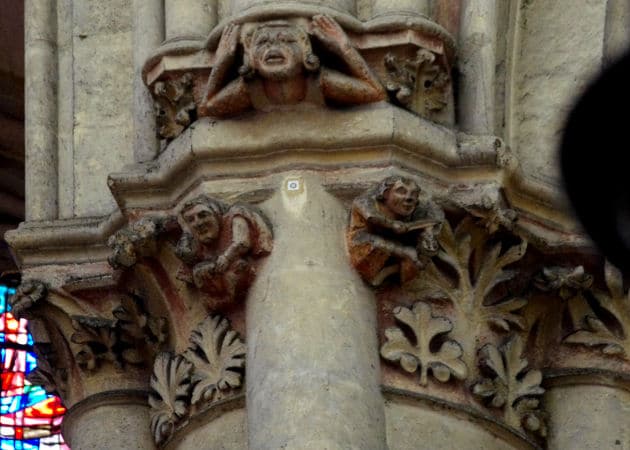
The musicians
A tambourine player faces a viol player. The four tuning pegs carved on the instrument’s neck suggest a four-stringed viol. These figures were painted in the 13th century and repainted in the 14th century.
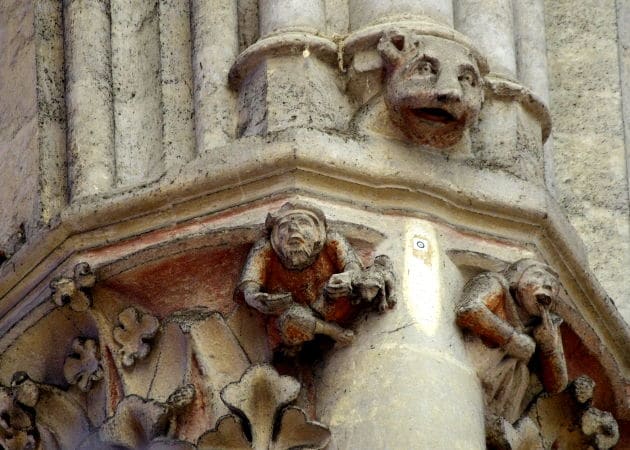
The beggar and the rich man
A beggar carrying an alms bowl, accompanied by a dog, faces a wealthy, well-fed man holding two fingers to his mouth. The scene may evoke the biblical story of the rich man and poor Lazarus.
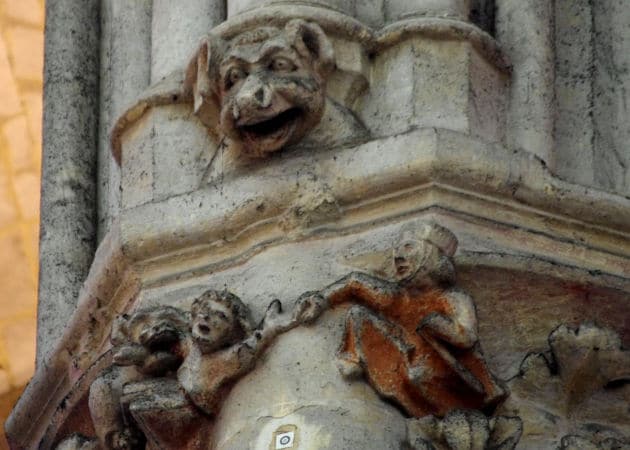
The mother, the child and the monster
A woman tries to pull her child away from a creature with a mastiff-like head and a reptilian tail. The monster holds the child’s arm in its jaws. The mother braces her foot against the column to pull harder: a detail that conveys the scene’s full tension.
A mysterious faceless figure
Opposite an angel with clasped hands stands a hooded figure with no face. The smooth surface of the stone suggests that the face may never have been carved. Could it be a ghost? The figure retains all its mystery.
A stone garden at the tops of the piers
Foliage is the recurring theme in the capitals’ decoration. Simple or lobed palmettes appear alongside leaves recalling ivy, oak, maple, hawthorn, box and geranium.
Some plants are easy to recognise; others are stylised and merge with the curves of the carving. The eye moves from familiar shapes to more freely composed motifs.
In medieval symbolism, the pier can evoke a tree trunk, while the capital spreads out its foliage. This decoration accompanies the passage from the earthly realm to the heavenly space of the soaring vaults.
In the ambulatory, the capitals also feature simple foliage designs. Traces of paint can still be seen in places.
Warriors, dragons and fantastic creatures
Between the chapels of Sainte-Angadrême and Saint-Léonard, a pier rebuilt in the 16th century bears a capital inhabited by fantastic creatures.
One warrior brandishes a scimitar before a dragon. Another is in trouble: his leg is caught in a creature’s jaws as he holds a club.
Alongside them appear hybrid beings: an animal with a human head and antlers, a winged creature with a lion’s body, and a dragon with gilded wings. Some figures retain painted decoration.
This bestiary reveals another facet of the cathedral’s sculpture, where imagination intertwines with architectural forms.
Take time to look up
On your next visit to Saint-Pierre Cathedral in Beauvais, pause to look at the capitals in the choir and ambulatory. An expression, a musical instrument, a leaf or an unexpected silhouette: each detail opens up a new avenue of discovery.
From pier to pier, let yourself be surprised by this sculpted world, which has been part of the building’s history for centuries.