
Beauvais and Besançon: two astronomical clocks, one masterpiece by Auguste-Lucien Vérité
Only a few years apart, Auguste-Lucien Vérité created two extraordinary astronomical machines for the cathedrals of Besançon and Beauvais. Comparing them reveals the evolution of the same clockmaker towards ever more ambitious and monumental mechanical creations.
From Besançon to Beauvais
When discussing the great French astronomical clocks of the 19th century, two monuments are inseparable from the name of Auguste-Lucien Vérité: the astronomical clock of Saint John’s Cathedral in Besançon and the one in Saint Peter’s Cathedral in Beauvais.
The Besançon clock was built between 1858 and 1860. A few years later, Vérité began a new creation in Beauvais, designed between 1865 and 1868. Both machines reflect the same fascination with time measurement, astronomical cycles and the mechanical representation of the world.
Yet they are far from identical. Comparing them shows how Vérité reused some of the principles explored in Besançon while giving the Beauvais clock a particularly spectacular architectural, mechanical and theatrical dimension.
Two cathedrals, two monumental machines

The Besançon astronomical clock
Installed in a lower room of the bell tower of Saint John’s Cathedral, the Besançon clock is one of Vérité’s major achievements.
Its remarkably dense architecture brings together numerous dials around a visible mechanism, crowned by sculpted figures and automata.
Time, dates, seasons, lunar phases, tides, eclipses and signs of the zodiac: the machine closely combines clockmaking with the mechanical representation of astronomical phenomena.
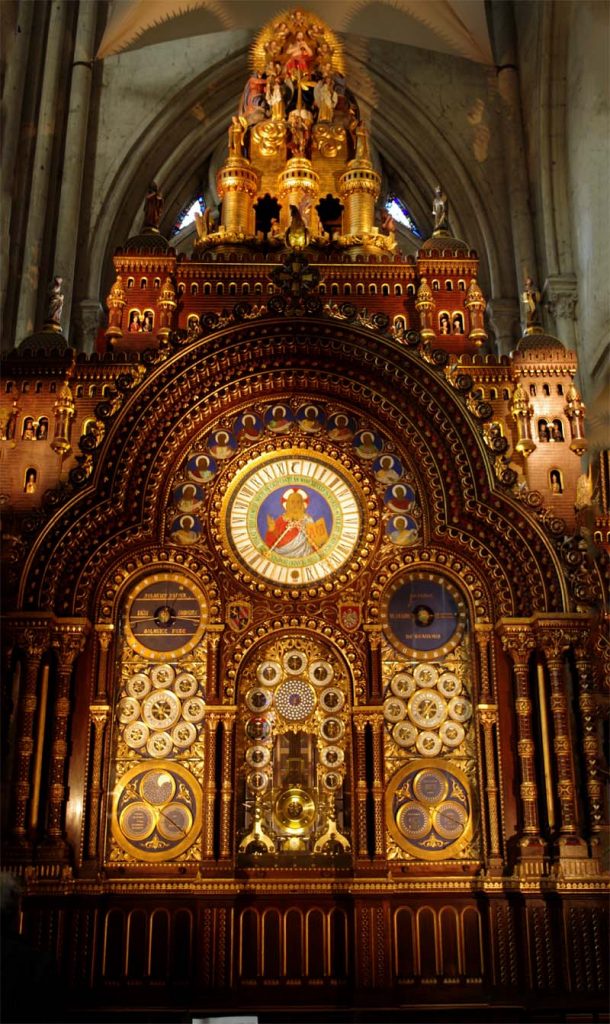
The Beauvais astronomical clock
Only a few years after Besançon, Vérité undertook a machine of an entirely different scale for Saint Peter’s Cathedral in Beauvais.
Here the clockwork is incorporated into an immense Romanesque-Byzantine inspired structure, where dials, mechanisms, figures and architecture combine to create a true monument within the cathedral.
Its 52 dials display timekeeping, calendrical, astronomical, geographical and liturgical information, while its automata take part in a monumental representation of the Last Judgement.
From Besançon Cathedral to Beauvais Cathedral
Less than a decade separates the creation of the two machines. Their close chronology provides a remarkable insight into one of the most productive periods in Auguste-Lucien Vérité’s career.
Work begins on the Besançon clock
Vérité begins construction of the astronomical clock intended for Saint John’s Cathedral.
Completion of Besançon
The machine brings together 57 dials providing 122 astronomical, calendrical and time-related indications.
Vérité begins the Beauvais clock
At the request of Bishop Joseph-Armand Gignoux, Vérité begins a new astronomical clock intended for his home city of Beauvais.
The Beauvais machine is completed
The ensemble reaches an exceptional scale: around 90,000 components, 52 dials and dozens of automata.
Installation in Saint Peter’s Cathedral
Installation of the great astronomical clock in Saint Peter’s Cathedral begins from 1876.
Besançon and Beauvais side by side
Figures alone cannot summarise two machines of such complexity, but they help reveal the considerable change in scale between Vérité’s two creations.
| Feature | Besançon | Beauvais |
|---|---|---|
| Monument | Saint John’s Cathedral | Saint Peter’s Cathedral |
| Construction | 1858–1860 | 1865–1868 |
| Clockmaker | Auguste-Lucien Vérité | Auguste-Lucien Vérité |
| Height | 5.80 m | approximately 12 m |
| Width | 2.50 m | monumental structure more than 5 m wide |
| Mechanical components | more than 30,000 | approximately 90,000 |
| Dials | 57 | 52 |
| Indications | 122 documented indications | numerous timekeeping, astronomical, calendrical, geographical and liturgical indications |
| Astronomy | Moon, seasons, zodiac, eclipses, tides… | Sun, Moon, sidereal time, eclipses, tides, starry sky, planets… |
| Automata and decoration | religious figures, automata and the risen Christ | 68 automata taking part notably in the representation of the Last Judgement |
| Overall character | a highly concentrated astronomical clock contained within a 5.80-metre structure | a true monumental mechanical architecture approximately 12 metres high |
Beauvais is not simply an enlarged Besançon
Comparing the two machines first reveals a clear continuity: in both cases Vérité sought to combine timekeeping, astronomical phenomena and highly complex mechanical engineering.
Beauvais, however, represents a profound change in scale. The machine is no longer simply housed within a clock case: it becomes a genuine architectural structure approximately twelve metres high.
Alongside the abundance of astronomical information, Vérité developed a monumental theatrical dimension in which automata and architectural decoration become an integral part of the mechanical spectacle.
The chronology and technical characteristics therefore make it possible to see Beauvais as a new stage in Vérité’s work, developed after the experience gained with the Besançon clock.
The same science, two different presentations
Besançon: astronomical density
The Besançon clock is remarkable for the density of its information. Its 57 dials provide 122 indications within an ensemble less than six metres high.
- time and calendars;
- seasons and zodiac;
- phases of the Moon;
- eclipses;
- tide times;
- geographical and astronomical indications.
Beauvais: astronomy becomes a monument
In Beauvais, Vérité developed a design in which mechanics and astronomy are incorporated into a genuine architectural façade.
- 52 visible dials;
- approximately 90,000 components;
- 68 automata;
- celestial planispheres;
- lunar and solar indications;
- mechanical representation of the Last Judgement.
The number of dials alone cannot measure the complexity of an astronomical clock. Besançon has more dials, while Beauvais develops a much larger ensemble in which mechanics, astronomy, architecture and automata are brought together within a single monumental composition.
A clockmaker and mechanical engineer born in Beauvais, Vérité was one of the leading French makers of monumental clocks in the 19th century.
Two clocks that help us understand one clockmaker
Studying Besançon and Beauvais together allows us to go beyond the description of two individual monuments. These machines directly illuminate the career and ambitions of Auguste-Lucien Vérité.
In Besançon, he demonstrated his ability to coordinate a very large number of timekeeping and astronomical indications within a complex mechanism. In Beauvais, only a few years later, this research took on an even more monumental dimension.
The existence of these two major works therefore places the Beauvais astronomical clock within the wider history of French astronomical clockmaking in the 19th century.
In Beauvais, Vérité brought his project to an exceptional scale
Understanding the Besançon clock makes it possible to appreciate more fully the ambition of Vérité’s later creation in Beauvais.
With approximately 90,000 components, 52 dials, 68 automata and a height of around twelve metres, the astronomical clock in Saint Peter’s Cathedral is simultaneously a timekeeping machine, an instrument for representing astronomical phenomena and an immense mechanical theatre.
Today it remains a major testimony to the work of Auguste-Lucien Vérité and allows visitors to discover the culmination of a line of research begun several years earlier in Besançon Cathedral.
Main sources
The characteristics presented on this page are based in particular on heritage records from the French Ministry of Culture, institutional information concerning the Besançon astronomical clock, and documentation published by Association Beauvais Cathédrale.
Discover one of Auguste-Lucien Vérité’s major creations
The astronomical clock of Saint Peter’s Cathedral offers visitors the opportunity to discover a monumental machine where clockmaking, astronomy, calendars, automata and 19th-century heritage come together.